

Health Tech Sessions – Life Sciences reveals first speakers for 2026
26 juni 2026
This day puts the patient and society at the centre. Medical innovation only matters when it reaches people, improves care and helps healthcare systems deliver better outcomes. That road is rarely simple.
From personalised medicine and cell and gene therapy to clinical adoption, logistics, data, production and patient access, Health Tech Sessions – Life Sciences explores what happens after the scientific breakthrough.
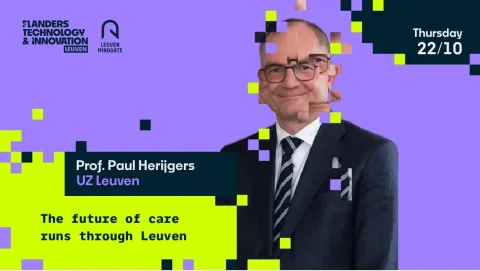
The future of care runs through Leuven
Prof. Paul Herijgers
CEO of UZ Leuven and professor at KU Leuven
Prof. Paul Herijgers is CEO of UZ Leuven and professor at KU Leuven. He is a cardiac surgeon by training and has built a career at the intersection of clinical care, academic medicine, hospital leadership and innovation.
As CEO, he leads one of Belgium’s most important university hospitals: a place where specialised care, research, education and innovation come together. UZ Leuven is internationally recognised for its clinical excellence and research-driven care, and plays a central role in the Leuven health and life sciences ecosystem.
Paul Herijgers will reflect on the future role of UZ Leuven: how a top hospital can remain a place where the most complex medical challenges are treated, where innovation is translated into care, and where technological progress remains connected to the human reality of patients and healthcare professionals.
The real question is not only what becomes possible. It is how those possibilities become meaningful care.
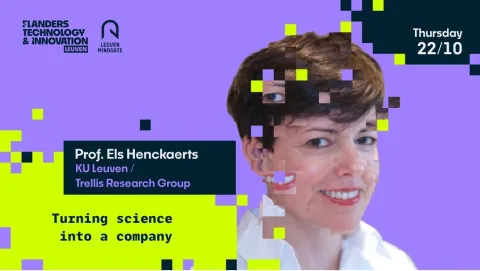
Turning science into a company
Prof. Els Henckaerts
Professor at KU Leuven & Head of Trellis Research Group
Prof. Els Henckaerts is a professor at KU Leuven and head of the Trellis Research Group, where her work focuses on adeno-associated virus biology and its applications in gene therapy. Her research explores how harmless viruses can be used as delivery vehicles for advanced therapies that aim to repair or replace defective genes.
Els also co-founded Handl Therapeutics, a KU Leuven spin-off focused on gene therapy for complex neurological diseases. The company was later acquired by UCB, marking an important example of how Leuven-based scientific expertise can move into a larger pharmaceutical context.
In this session, Els brings a rare combination of perspectives: academic researcher, gene therapy expert, spin-off founder and mentor. She will reflect on what happens when a scientific breakthrough moves beyond the lab and enters the world of IP, capital, partnerships, manufacturing and patient impact.
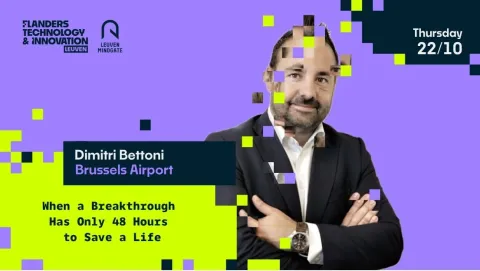
When a breakthrough has only 48 hours to save a life
Personalised medicine promises more precise, targeted and effective care. But a medical breakthrough does not end in the lab. It only becomes real when it reaches the patient. But what if that chain has only 48 hours to work?
Dimitri Bettoni
Head of Cargo at Brussels Airport
Dimitri Bettoni from Brussels Airport brings the infrastructure perspective. Airports are no longer just transit points in this story. They are becoming strategic nodes in healthcare: handling customs, cold chain, storage, security, speed and coordination between actors who cannot afford mistakes.
How do you move sensitive medical products safely, quickly and reliably through customs, storage, cold chain systems and onward transport?
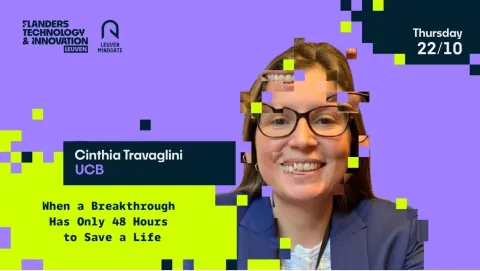
Cinthia Travaglini
Head of Clinical Supply Chain at UCB
Cinthia brings the pharmaceutical and innovation perspective. As therapies become more patient-specific, logistics can no longer be added at the end of the innovation process. It needs to be designed in from the start. What are the risks when therapies become more complex, more fragile and more time-sensitive? And how does a pharmaceutical company think beyond the science itself?
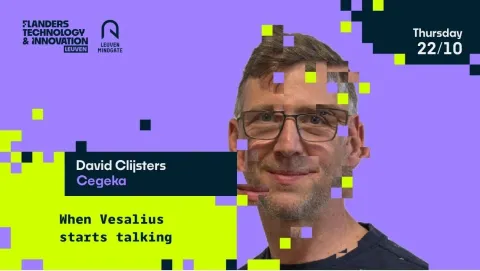
When Vesalius starts talking
David Clijsters
Senior Data Scientist & AI expert at Cegeka
Cegeka is a European IT solutions provider working across sectors including healthcare. Its work includes digital transformation, data, cloud, cybersecurity and software solutions for hospitals, care organisations, laboratories, pharma and other healthcare-related environments.
For the new Vesalius Museum, Cegeka developed an AI-powered chatbot experience that brings Andreas Vesalius to life through a hologram. In this session, David Clijsters takes us behind the scenes, exploring how medical history can become an interactive visitor experience.
The session follows the Vesalius Museum demo and adds another layer to the story. First, we explore the body through digital anatomy.
Then, we explore how AI can help translate medical knowledge for visitors, care professionals, researchers and the wider public.
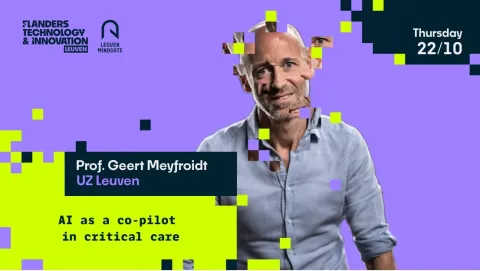
AI as a co-pilot in critical care
Prof. Geert Meyfroidt
Head of Department, Intensive Care Medicine at UZ Leuven and Professor at KU Leuven
Prof. Geert Meyfroidt is an intensivist at UZ Leuven and professor at KU Leuven. His clinical and research work focuses on intensive care medicine, neuro-intensive care, patient monitoring, data analysis and computerized decision support in critical care settings.
In intensive care, every decision matters. Patients generate huge amounts of data. Vital signs, lab results, medication, monitoring systems and clinical observations all move at once. Care teams need to interpret that information under pressure, often with limited time and high responsibility.
For Prof. Geert Meyfroidt, AI can help in that reality. Not as an autopilot, but as a co-pilot in critical care.
AI can support clinicians by analysing complex patient data, detecting patterns and warning signals, and helping care teams decide when a patient may need closer attention. It can act as an extra layer of vigilance in an environment where speed and precision matter.
But the clinician remains responsible. Clinicians do not blindly trust AI. They use it as one more tool to support better decisions for patients.
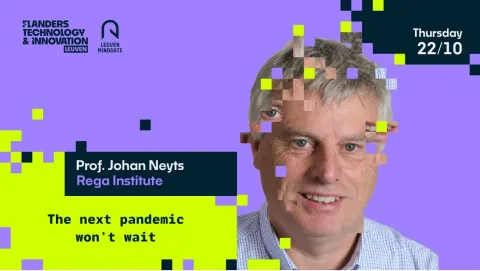
The next pandemic won’t wait
Prof. Johan Neyts
Professor of Virology at KU Leuven and Head of the Laboratory of Virology, Antiviral Drug and Vaccine Research at the Rega Institute for Medical Research
COVID-19 proved that medical breakthroughs can happen at astonishing speed. Vaccines were developed in record time. Scientific teams collaborated across borders. Regulators moved faster. Governments invested heavily. Healthcare systems adapted under enormous pressure.
So why does medical innovation often move so slowly in normal times?
In this session, Prof. Johan Neyts from KU Leuven’s Rega Institute takes us into the science and strategy of pandemic preparedness. The next pandemic is not a question we can push into the distant future. Emerging viral threats such as Ebola, hantavirus and other pathogens show that outbreaks remain part of our reality.
The line-up continues to grow
Health Tech Sessions’ is the name of the two-day B2B health programme of FTI Leuven 2026.
On Wednesday 21 October, the focus is on Hardware & AI: the technologies, companies and investment challenges behind the next generation of health tech.
On Thursday 22 October, the programme shifts to Life Sciences, with a different set of questions around medical breakthroughs, translation and patient care.
Tickets now available
Want to join Health Tech Sessions – Life Sciences on Thursday 22 October 2026 in Leuven?
Tickets are day-specific. A ticket for ‘Health Tech Sessions – Life Sciences gives access to the programme on Thursday 22 October only.
To attend ‘Health Tech Sessions –Hardware & AI’ on Wednesday 21 October, a separate ticket is required.


